Is it time for CTF on silage land?
Is it time to consider controlled traffic farming when it comes to making silage? This is a topic that has long been discussed but apart from “arable silage” there doesn’t seem to be much of an adoption with the farmers I speak to. But just maybe now is the time because this is definitely a time of change in agriculture.
Change is probably a truism for all businesses but world agriculture seems to be going through a huge change phase at the moment. Climate change, together with environmental and economic pressures seem to be effecting farmers all over the globe. And governments are not holding back either, be it an attempted land grab from a neighbouring country or a new tax regime to fill their dwindling exchequer, the end result always seems to be unhelpful for the world’s food producers.
But it’s not all doom and gloom, in the face of change and challenge I remain optimistic about agriculture. As I’ve said many many times, there are over 8 billion people in the world; around a third of them are hungry and it’s our job to feed them. So how do we rise to the challenge?
Well it’s pretty certain that just doing the same old is just not going to cut it - we need to question everything we do, and look for inspiration in all that we do. And this is why I think controlled traffic farming, or CTF, needs to be re-examined.
What is Controlled Traffic Farming?
This is one of those “what is says on the tin” sort of things. The idea is to limit where the vehicles run in a field to minimise the area that is “trafficked” and maximise the area that doesn’t get driven on. CTF is common in arable farming because it limits the compaction onto all that beautifully tilled soil structure. CTF does need some careful planning though because machines vary in working width. In most cereal production systems it’s the 6m block that is the starting point. Six metre cultivators, six metre drill, 12m rolls and 36m sprayers are all going to fit into the growing phase, but then you’ll need a 12m combine header with a unloading auger to allow the trailers to be 12m away from the centre of the combine, it’s all big boys toys.
What is the payback with controlled traffic farming?
This whole principal is all about increasing yields; and in wheat it is common to see yields up to 10% and sometimes closer to 15% above no CTF yields. That’s quite impressive so why haven’t we bothered to embrace CTF for the production of silage?
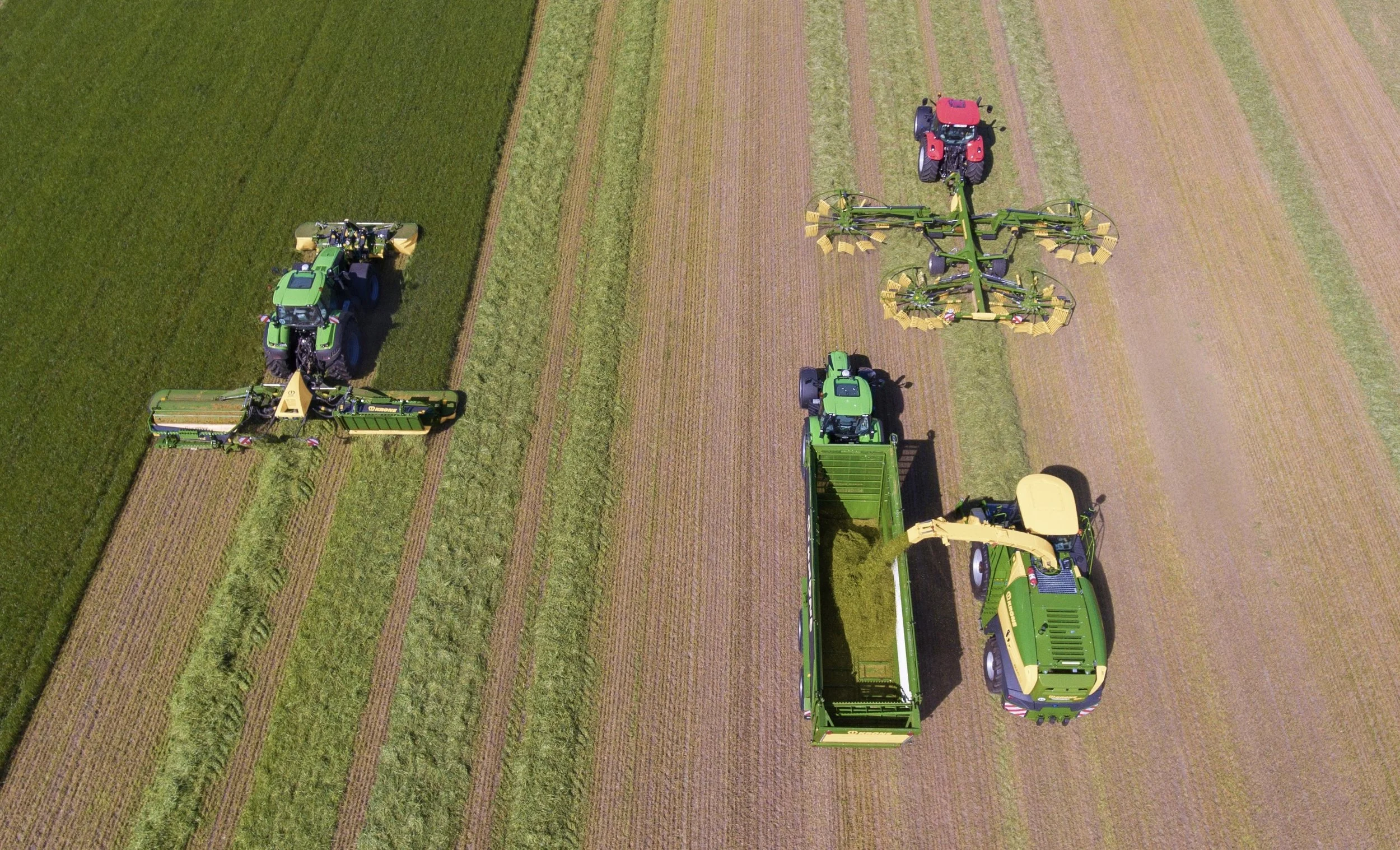
Should this Krone forage kit be using CTF?
Is there a yield increase from CTF on grass silage?
Simple answer to this one is yes there is - and it’s significant. There is a big range of increases in yield because the conditions we harvest grass in vary so hugely. In a wet spring, traffic can do some serious damage to the sward but in a middle of a droughty 2nd or 3rd cut, with the ground rock hard it’s less likely to be a benefit.
Even so the numbers might still surprise you, because a 14% loss of yield from trafficked areas is the low end of the scale! In more extreme conditions it is common to record a 30% reduction in yield in the subsequent cut of silage. And remember, if that damaged happened when taking the first cut, which lets face it, is the most likely time, it is going to negatively impact yield for the rest of the year. And probably for years to come too!
How much of the land is trafficked when cutting silage?
Well when I started to research this I kept coming across this 60% figure - traditional systems traffic 60% of the growing area. Now that seemed very high to me so I started doing some maths and plotting just where all the traffic ends up across a field. I assumed all the tractors have a 650mm rear tyre that created a 700mm wide “foot print” because obviously you would running reduced pressures to protect the grassland.
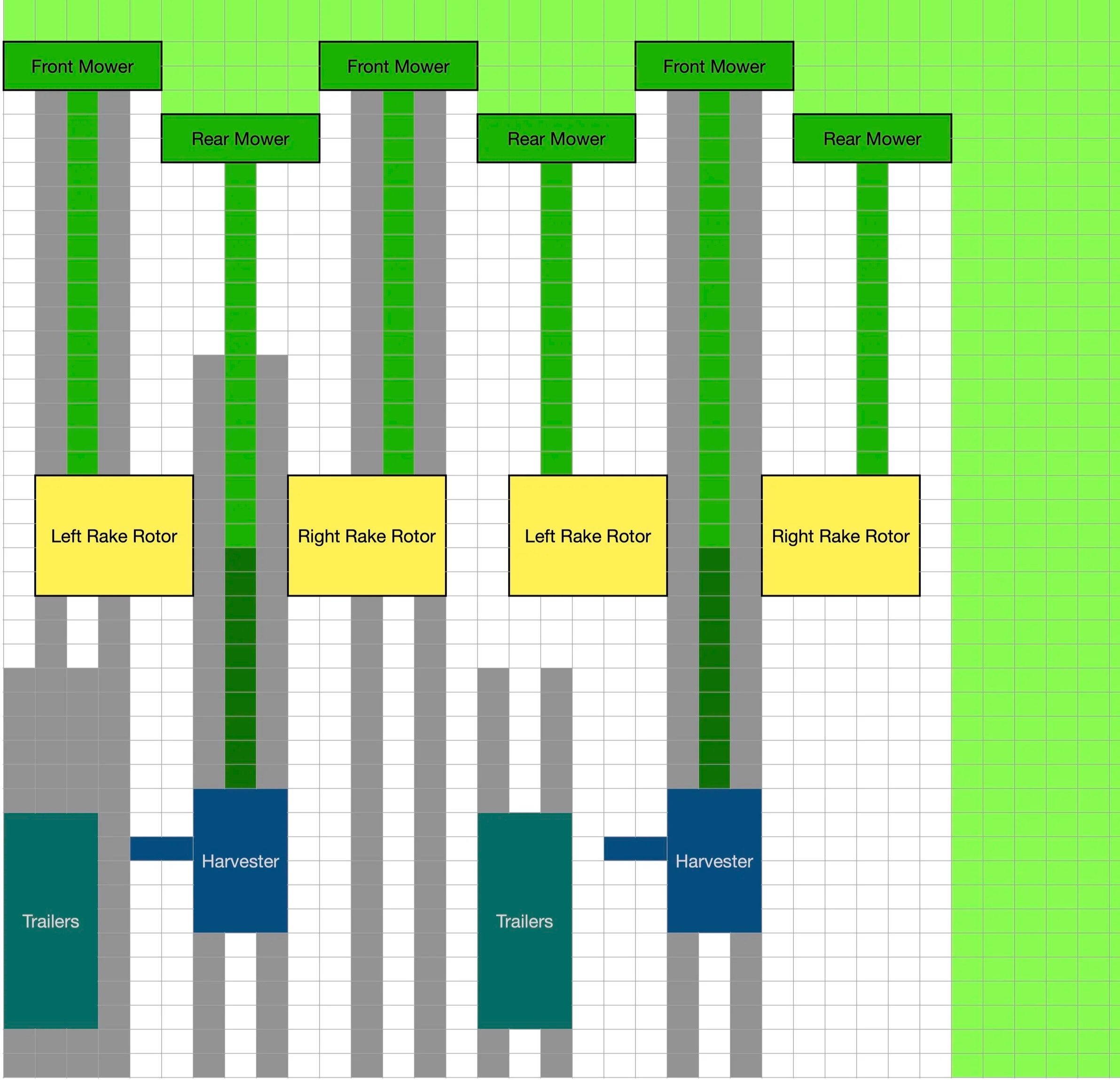
There is a lot of grey stuff on this!
On this basis with a front and rear mower combination being followed by a 9m rake straddling every 3rd swath, and a chopper running behind, I thought it was a fairly controlled system. The trailers are more of a problem because they don’t fit behind any other wheeling but still, that can’t be too bad can it?
Well yeah it can because even in the middle of the field on straight runs, at least 50.5% of the field was run over by tyres! And that’s before we even consider the tedder and trailers straightening to the gate. So this led me to try and find a more acceptable solution and then try and put some costs to it all. The table below looks at different mower and rake combinations plus a pure CTF system with trailers running on previous wheelings.
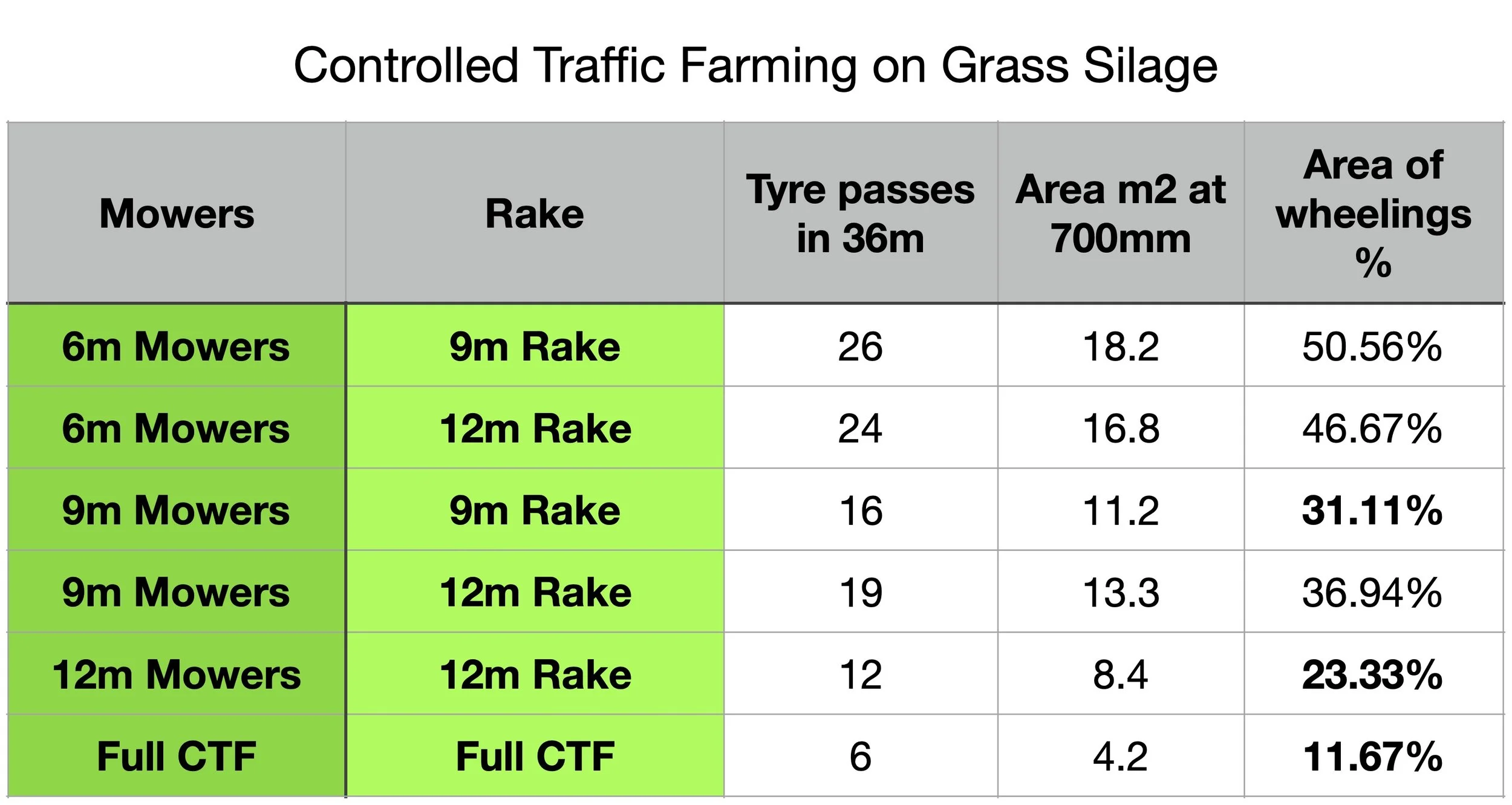
It’s interesting (well at least I find it interesting) to note how much variation these is between the different systems but to get a proper feel for the financial impact you need to put some costs to this. Its important to note that up to 90% of the yield impact comes from the first pass of a tractor with subsequent passes having little additional impact - unless it is on really tender ground obviously.
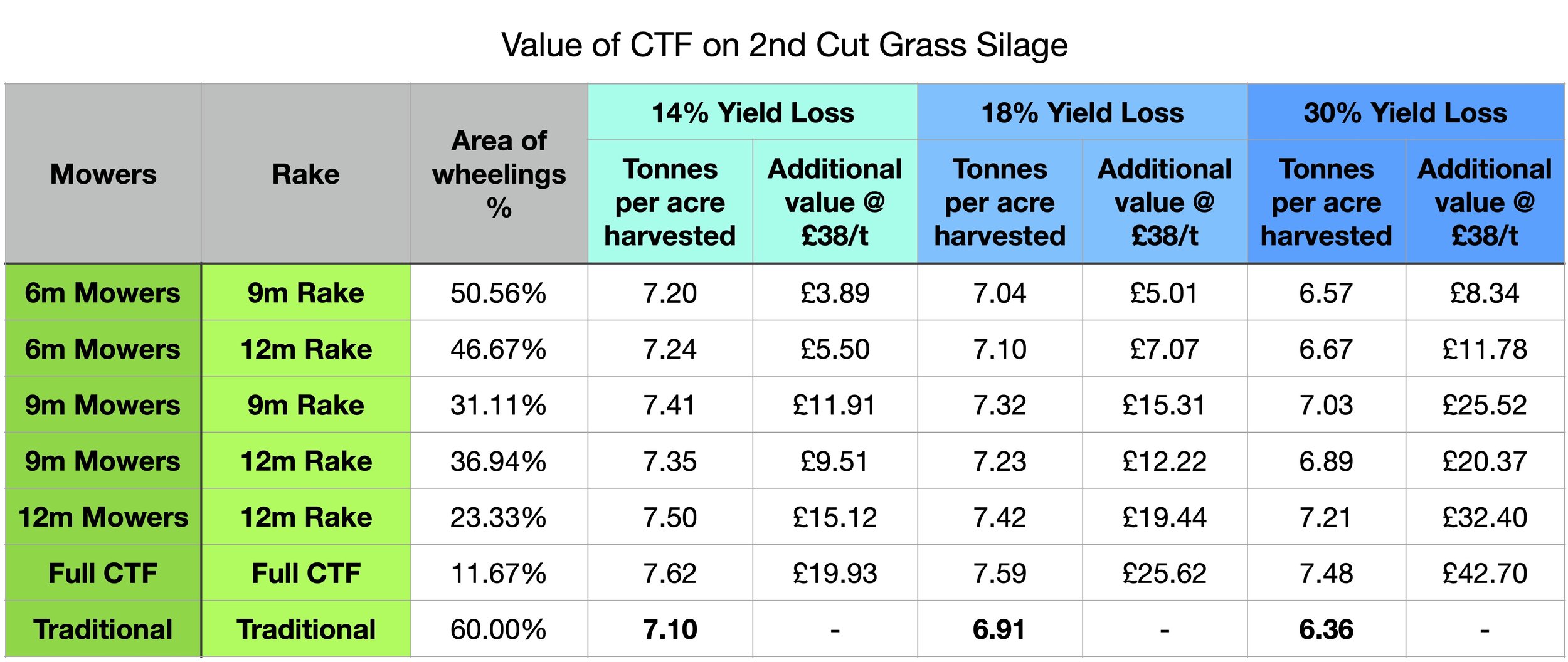
There are some fairly chunky numbers in this table; an extra £20 per acre is going to get your attention if you’re feeding a lot of hungry tummies with grass silage. And it’s worth remembering, that the costs of producing and acre of silage are the same in all of these, its just the yield that varies. So if this has spiked your interest it begs the question:
How to implement CTF for grass silage?
Obviously the kit selection is the most important aspect so you would need to choose the kit or a contractor that is going to be able to meet your requirements. But that shouldn’t be too difficult because most of us are familiar with twin and triple mowers and 9m to 12m rakes. The full 12m system is a bit more complex as it needs some monster mowers and the Skye Bridge for a chopper spout (very long for those not familiar with Western Scotland)
Next you need to decide how each field is going to be tackled; think of it as setting the tramlines in a cereal crop. This is easily done on some navigation systems, I am familiar with the John Deere GreenStar system and it can all be done from the office with a laptop once the fields are mapped. If you are using a contractor who relies on guidance, they can probably do this for you - or at least with you.
That’s the easy bit, the really critical part is re-educating the drivers to make sure they drive where they are supposed to! The “field team” are not really too much trouble, because once they have guidance the maps and work plans just get pinged to the tractor and away they go. The difficult part is keeping the carters in line because, left to their own devices, they are as bad as a bunch of Touring Car racers on the final lap! But don’t despair, cereal growers have won their own battle and so can you - the key is to set a strict traffic flow that applies to all fields.
I get them to imagine there is a two lane ring road around the field on the headland and they are ONLY allowed to leave it to go up and down alongside the harvester. Where ever they are loaded, they MUST get back on the ring road to get to the gate. There are always a few comments about how this “slows the job down” but whenever I have timed it, on average its a handful of seconds per load. To me, the advantages make this more than worthwhile, but maybe you have a different point of view?
If you want to discuss how to implement CTF on your silage land or would like to discuss any other aspects covered in this series, contact me at jeremy@silageconsultant.co.uk